
Tech
Amazon Introduces Ocelot Chip to Solve Problems in Quantum Computing

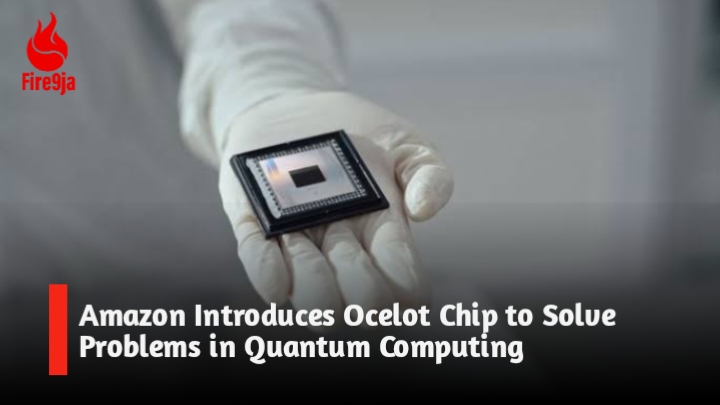
Amazon Web Services (AWS) has unveiled its inaugural quantum computing chip, named Ocelot, marking a significant stride in the rapidly evolving field of quantum technology.
This prototype chip is designed to tackle one of quantum computing’s most formidable challenges: error correction. AWS asserts that Ocelot could reduce the costs associated with quantum error correction by up to 90%, potentially accelerating the development of practical, fault-tolerant quantum computers.
Quantum computers operate using qubits, which, unlike classical bits, can represent both 0 and 1 simultaneously—a property known as superposition.
However, qubits are highly sensitive to environmental disturbances such as heat, vibrations, and electromagnetic interference, leading to computational errors.
Traditional methods to correct these errors require a substantial number of additional qubits, making quantum systems complex and costly.
Ocelot addresses this issue by incorporating “cat qubits,” a specialized type of qubit inspired by Schrödinger’s cat thought experiment.
These cat qubits are engineered to inherently suppress certain types of errors, thereby reducing the need for extensive error correction mechanisms. This innovation simplifies the architecture of quantum computers and enhances their scalability.
Oskar Painter, AWS’s Head of Quantum Hardware, emphasized the importance of prioritizing error correction in quantum computing development. He stated, “We believe that if we’re going to make practical quantum computers, quantum error correction needs to come first. That’s what we’ve done with Ocelot.”
The Ocelot chip consists of two integrated silicon microchips, each measuring approximately one square centimeter.
These chips are layered together with a thin film of the superconductor tantalum, processed for faster oscillation, and currently run five functional cat qubits.
This development positions AWS alongside other tech giants making significant advancements in quantum computing.
Recently, Microsoft unveiled its Majorana 1 chip, and Google introduced its Willow chip, both highlighting progress in stability, scalability, and performance.
While Ocelot remains a research prototype, AWS plans to refine and scale the technology. The company acknowledges that achieving practical, fault-tolerant quantum computers capable of solving complex problems beyond the reach of classical systems may still be a decade or more away.
Nevertheless, Ocelot represents a crucial step toward that goal, potentially accelerating the timeline for practical quantum computing applications.







For tech beginners or AI beginners who do not know how to use it, here is a simple guide on how to use AI to edit your photos.
Today, we will be looking at something as simple as changing your outfit, the colour of it or anything else you want to change.
Here are the steps to edit your photos using AI:
- Go to ChatGPT or any other AI tool you are using.
- Click on the attachment icon to attach the image you want to edit.
- Upload the photo you want to make changes to.
- Type your prompt and clearly state what you want the AI to change. For example: “Change the colour of the outfit in this image to red.”
- Send the prompt and allow the AI to edit the image based on your instruction.
- If you do not like the result, you can give another prompt telling the AI exactly what you want changed or corrected.
You can use the same method to change the colour of your outfit, change your hairstyle, remove something from the photo, change the background or make other edits to your image.

Meta has launched Muse, an AI agent designed to perform tasks across different apps and services on behalf of users.
The AI agent can perform tasks such as sending emails, booking travel and making payments, with users able to control which apps and services it can access.
Meta said Muse will require user approval for sensitive actions, including sending emails and making purchases. The AI agent is initially available in the United States.
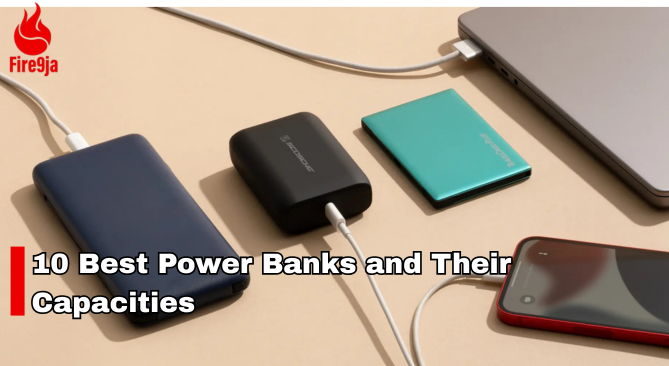
10 Best Power Banks to Use and Their Capacities
- Oraimo — 10,000mAh
- Itel — 10,000mAh
- Samsung — 10,000mAh
- Anker — 10,000mAh
- Xiaomi — 10,000mAh
- Infinix — 10,000mAh
- Tecno — 10,000mAh
- Romoss — 20,000mAh
- Baseus — 20,000mAh
- New Age — 20,000mAh

Walid Acherchour Backs Lamine Yamal to Win 2026 Ballon d’Or

Zlatan Announces Wedding Date With Longtime Partner Davita

11 New K-Dramas To Add To Your Watch-list This October 2026


-

 Entertainment7 hours ago
Bridgerton Announces Violet and Edmund Love Story Spin-Off
-

 Entertainment7 hours ago
Mr Eazi Sparks Reactions With Comment About Expecting Twins
-

 Entertainment7 hours ago
From Men in Black to Aladdin: 10 Will Smith Movies
-
 Entertainment7 hours ago
11 New K-Dramas To Add To Your Watch-list This October 2026
-

 Entertainment7 hours ago
10 Global Music Stars Who Became Famous At A Young Age
-
 Sport7 hours ago
Walid Acherchour Backs Lamine Yamal to Win 2026 Ballon d’Or
-
 Entertainment7 hours ago
Zlatan Announces Wedding Date With Longtime Partner Davita