
News
House Orders JAMB to Remit N3.6 Billion to Federal Government in 30 Days


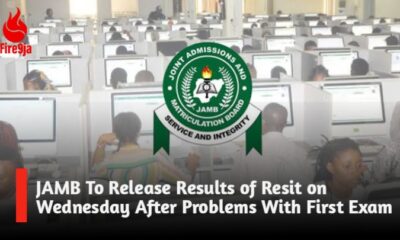
The House of Representatives has directed the Joint Admission and Matriculation Board (JAMB) to remit a sum of N3.602 billion to the Federal Government’s Consolidated Revenue Fund (CRF).
This order was issued during an investigative hearing held in Abuja, led by Rep. Bamidele Salam, Chairman of the House Public Accounts Committee.
Salam clarified that this remittance is not open to any personal interpretation, but rather a clear-cut legal obligation.
He noted that the issue at hand had nothing to do with the difference between a 25 percent or 50 percent revenue remittance, as was being argued by JAMB.
Rather, it was a matter of adhering to established laws and financial regulations governing public institutions.
The committee, in a unanimous decision, instructed JAMB to remit the outstanding N3.602 billion to the Fiscal Responsibility Commission (FRC) and provide documented proof of the remittance within a 30-day window.
This decision comes after the FRC brought JAMB before the committee, alleging that the board had failed to remit its operating surplus in full.
Mr. Bello Aliyu, a representative of the FRC, provided insight into the financial discrepancies.
He explained that as of 2021, based on the report submitted to the committee, JAMB’s liabilities stood at N390.725 million.
However, after receiving JAMB’s 2022 audited financial statement, the FRC recalculated the liabilities, which have since increased to N3.602 billion.
Aliyu mentioned that the FRC had formally notified JAMB about the updated liability through a letter dated March 14, followed by a reminder issued on August 31.
Despite these correspondences, he disclosed that the FRC had not received any response from JAMB regarding the matter.
Addressing these allegations, JAMB’s Director of Finance and Administration, Mr. Mufutau Bello, responded by shedding light on the board’s perspective.
According to Bello, the crux of the issue lies in the difference in remittance figures.
He explained that the FRC had been pushing for JAMB to remit 50 percent of its revenue to the government, while the board had been consistently remitting 25 percent, as per a concession granted by the Office of the Accountant-General.
Bello pointed out that in 2019, JAMB’s dedication to revenue remittance led the Federal Government to reduce the cost of its registration fee from N5,000 to N3,500, a move that was designed to benefit all Nigerians.
He emphasized that JAMB had not increased any of its charges over the last eight years, and had in fact reduced them, leading to a decrease in its revenue base.
“We have consistently followed the 25 percent remittance policy year after year, and this has been done in line with our role in the education sector,” Bello stated.
He argued that, based on the 25 percent remittance rate, JAMB has actually over-remitted its surplus over the years.
The board has always operated under the assumption that the 25 percent rate, as approved by the Accountant-General, was the correct standard to follow.
However, the FRC is now pushing for JAMB to remit 50 percent of its revenue, a significant increase from the previous rate.
This, according to Bello, is the core of the disagreement between the two agencies.
Bello further stressed that if the committee were to assess JAMB’s remittance based on the 25 percent rate, the board has been more than compliant and has fulfilled its financial obligations.
“We’ve done our part in supporting the government’s efforts by keeping our fees low while adhering to the 25 percent rule,” he said.
The hearing concluded with the committee reaffirming its directive for JAMB to remit the N3.602 billion as calculated by the FRC and to provide evidence of the payment within 30 days.
This ongoing investigation highlights the complexities of revenue remittance among government agencies and the need for clarity in financial regulations.














The Chairman of Gboko Local Government Area of Benue State, Torseer Yina, has imposed a dusk-to-dawn curfew in the ancient town.
The curfew takes effect from Thursday, October 8, 2026, following unrest and violent protests in the area.
According to reports, the action was taken to contain the unrest and violent protests by members of BEMOA following the death of one of its members by unknown gunmen.
The protest, which was reportedly hijacked by hoodlums, turned violent after an angry mob burnt two vehicles belonging to the Benue State Civil Protection Guards.
The Gboko council chairman said the curfew takes effect immediately and warned that anyone caught flouting the order or breaching public peace would be decisively dealt with.

Nine people have died in a fatal road crash along the Ijebu-Ode-Benin Expressway in Ogun State.
The crash occurred on Monday at about 4:55pm around the Bethel area along the Ijebu-Ode/Ore axis of the expressway. It involved a white Toyota Hiace commercial bus belonging to Delta Line and a white Sino truck operated by Bill Gas Solution Ltd.
According to the Federal Road Safety Corps (FRSC), all nine people involved in the crash, comprising three males and six females, died in the incident.
The FRSC said the crash occurred while it was raining and the road was wet, with preliminary investigations identifying speed violation as the probable cause.
The FRSC rescue team arrived at the scene shortly after receiving the report, while the bodies of the victims were taken to the General Hospital Morgue in Ijebu-Ode.
The Ogun State Sector Commander, Oludare Ogunjobi, urged motorists, especially commercial drivers, to obey speed limits and exercise extra caution when driving in the rain.

Minister of Education, Dr Tunji Alausa, speaks on the role and importance of teachers in the world to celebrate Teachers’ Day today.
He spoke on technology and its advancement and shared that while it is going well, teachers can never be replaced.
“These tools can help teachers reach learners and tailor instruction, but the judgement, encouragement and human connection of a skilled teacher remain indispensable,” he said.
“Every doctor, engineer, scientist, entrepreneur and public servant has benefited from a teacher and could not have become what they are today without teachers,” the minister said.
“When we honour teachers, we honour the people who make every other profession possible.”

Walid Acherchour Backs Lamine Yamal to Win 2026 Ballon d’Or

Zlatan Announces Wedding Date With Longtime Partner Davita

11 New K-Dramas To Add To Your Watch-list This October 2026


-

 Entertainment9 hours ago
Bridgerton Announces Violet and Edmund Love Story Spin-Off
-

 Entertainment9 hours ago
Mr Eazi Sparks Reactions With Comment About Expecting Twins
-

 Entertainment9 hours ago
From Men in Black to Aladdin: 10 Will Smith Movies
-

 Entertainment9 hours ago
10 Global Music Stars Who Became Famous At A Young Age
-
 Entertainment9 hours ago
11 New K-Dramas To Add To Your Watch-list This October 2026
-
 Sport9 hours ago
Walid Acherchour Backs Lamine Yamal to Win 2026 Ballon d’Or
-
 Entertainment9 hours ago
Zlatan Announces Wedding Date With Longtime Partner Davita