
News
Obama Honors Quincy Jones as “The Man Who Was Music” in A Tribute

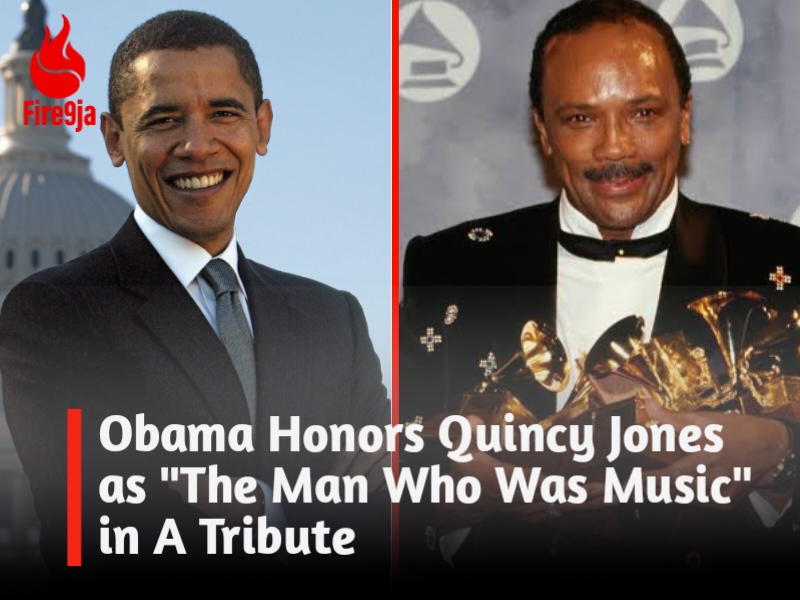
Former President Barack Obama paid a heartfelt tribute to legendary music producer Quincy Jones, highlighting his vast influence on music and culture.
In a post on his X handle, Obama celebrated Jones’ contributions, crediting him as a figure who was instrumental in shaping modern music and breaking barriers in the entertainment industry.
“For decades, Quincy Jones was music,” Obama wrote, reflecting on the long and remarkable career of the man behind some of history’s most celebrated music.
From producing Michael Jackson’s record-breaking Thriller album to composing the score for The Color Purple and collaborating with stars like Frank Sinatra and Ray Charles, Quincy’s impact was profound and wide-reaching.
Obama added, “It seemed like every big record—and every big film—had Quincy’s name on it.”
Quincy Jones’ reach in the music world is indeed vast.
As the mind behind Thriller, he helped create the best-selling album of all time, defining the sound of the 1980s and introducing new standards in production.
Working alongside Michael Jackson, Quincy not only produced hits like Beat It and Billie Jean but also crafted a sonic landscape that would set the bar for generations to come.
His role in shaping Jackson’s career brought him global acclaim, securing his place in music history.
However, Quincy’s influence went far beyond pop music.
His composition for the film adaptation of Alice Walker’s The Color Purple showcased his versatility, allowing him to bring his musical genius to Hollywood.
Through the film, Jones brought the struggles, resilience, and spirit of African Americans to the big screen in a profound way.
His soundtrack elevated the emotional impact of the film, earning him an Academy Award nomination and solidifying his reputation as a composer with the ability to resonate across various genres.
A pioneer in bridging racial divides, Quincy Jones’ work appealed to listeners of every background and every age.
From jazz and soul to pop and film scores, his music was universal, connecting people and defining eras.
Obama highlighted that by building a career that took him from the tough streets of Chicago to the glamorous heights of Hollywood, Quincy became a trailblazer for Black artists and executives alike.
His achievements opened doors for many in an industry that had long been challenging for Black professionals to thrive in at high levels.
Obama closed his tribute by offering comfort to Jones’ loved ones and fans, saying, “Michelle and I send our thoughts to Quincy’s friends, family, and everyone who has lived their lives to his songs.”
Quincy Jones’ legacy is seen not only in his music but in the countless artists he mentored and inspired.
His career spanned over seven decades, during which he won 28 Grammy Awards and received 80 nominations, making him one of the most decorated artists in Grammy history.
Beyond the awards, he was an advocate for social change and a visionary who used his platform to push for equality and justice.
Throughout his life, Quincy worked with music icons like Aretha Franklin, Ray Charles, and Frank Sinatra.
His collaborations with Frank Sinatra were particularly groundbreaking, bridging racial boundaries at a time when such partnerships were rare.
Together, they produced timeless hits like Fly Me to the Moon, helping Sinatra reinvent his sound and reach new audiences.
Quincy’s early work with Ray Charles also left a lasting impact on him, helping shape his understanding of music’s power to transcend racial divides and bring people together.













The Chairman of Gboko Local Government Area of Benue State, Torseer Yina, has imposed a dusk-to-dawn curfew in the ancient town.
The curfew takes effect from Thursday, October 8, 2026, following unrest and violent protests in the area.
According to reports, the action was taken to contain the unrest and violent protests by members of BEMOA following the death of one of its members by unknown gunmen.
The protest, which was reportedly hijacked by hoodlums, turned violent after an angry mob burnt two vehicles belonging to the Benue State Civil Protection Guards.
The Gboko council chairman said the curfew takes effect immediately and warned that anyone caught flouting the order or breaching public peace would be decisively dealt with.

Nine people have died in a fatal road crash along the Ijebu-Ode-Benin Expressway in Ogun State.
The crash occurred on Monday at about 4:55pm around the Bethel area along the Ijebu-Ode/Ore axis of the expressway. It involved a white Toyota Hiace commercial bus belonging to Delta Line and a white Sino truck operated by Bill Gas Solution Ltd.
According to the Federal Road Safety Corps (FRSC), all nine people involved in the crash, comprising three males and six females, died in the incident.
The FRSC said the crash occurred while it was raining and the road was wet, with preliminary investigations identifying speed violation as the probable cause.
The FRSC rescue team arrived at the scene shortly after receiving the report, while the bodies of the victims were taken to the General Hospital Morgue in Ijebu-Ode.
The Ogun State Sector Commander, Oludare Ogunjobi, urged motorists, especially commercial drivers, to obey speed limits and exercise extra caution when driving in the rain.

Minister of Education, Dr Tunji Alausa, speaks on the role and importance of teachers in the world to celebrate Teachers’ Day today.
He spoke on technology and its advancement and shared that while it is going well, teachers can never be replaced.
“These tools can help teachers reach learners and tailor instruction, but the judgement, encouragement and human connection of a skilled teacher remain indispensable,” he said.
“Every doctor, engineer, scientist, entrepreneur and public servant has benefited from a teacher and could not have become what they are today without teachers,” the minister said.
“When we honour teachers, we honour the people who make every other profession possible.”

Walid Acherchour Backs Lamine Yamal to Win 2026 Ballon d’Or

Zlatan Announces Wedding Date With Longtime Partner Davita

11 New K-Dramas To Add To Your Watch-list This October 2026


-

 Entertainment10 hours ago
Bridgerton Announces Violet and Edmund Love Story Spin-Off
-

 Entertainment10 hours ago
Mr Eazi Sparks Reactions With Comment About Expecting Twins
-
 Entertainment10 hours ago
From Men in Black to Aladdin: 10 Will Smith Movies
-

 Entertainment10 hours ago
10 Global Music Stars Who Became Famous At A Young Age
-
 Entertainment10 hours ago
11 New K-Dramas To Add To Your Watch-list This October 2026
-
 Sport10 hours ago
Walid Acherchour Backs Lamine Yamal to Win 2026 Ballon d’Or
-
 Entertainment10 hours ago
Zlatan Announces Wedding Date With Longtime Partner Davita