
News
Bangladesh Universities Close Amid Unrest Over Job Quota Protests

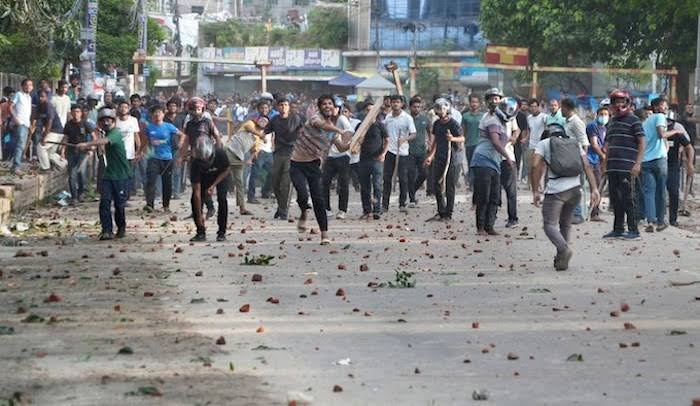
Bangladesh was plunged into turmoil this week as universities and educational institutions across the country abruptly closed their doors on Wednesday.
This decision came in response to violent riots that shook the capital city of Dhaka just a day earlier, tragically claiming the lives of six individuals.
The unrest erupted over widespread dissatisfaction with the government’s job allocation policies, particularly the contentious quota system that reserves 30% of positions for relatives of veterans from Bangladesh’s 1971 war for independence.
What began as peaceful protests demanding reforms quickly escalated into clashes between student demonstrators, pro-government factions, and law enforcement agencies.
In Dhaka, the prestigious Dhaka University promptly suspended classes following the outbreak of violence, with other universities following suit under government directives aimed at ensuring the safety of students.
The University Grants Commission endorsed these measures, citing concerns over escalating tensions and security risks on campuses nationwide.
The unrest was not confined to Dhaka alone, spreading to other major cities like Chattogram and Rangpur. Reports of violence, including clashes and property damage, prompted swift and decisive action from authorities.
Police conducted raids on the headquarters of the opposition Bangladesh Nationalist Party, resulting in the arrest of several individuals allegedly involved in the disturbances.
The issue of job quotas has long been a contentious one in Bangladesh, with critics arguing that the system perpetuates inequality and favors political affiliations.
A previous court decision in 2018 had temporarily suspended the quota system following mass student protests. However, a recent ruling by the High Court overturned this decision, reigniting frustrations among youth facing significant unemployment rates.
Government positions in Bangladesh are highly sought after due to their perceived stability and better compensation compared to private sector jobs.
The current system allocates a substantial portion of these positions to various groups, including women, Indigenous communities, and residents of underdeveloped districts, in addition to veterans’ families.
As authorities work to restore calm and address underlying grievances through dialogue and legal channels, the closure of educational institutions underscores the seriousness of the situation and the urgent need for resolution amid heightened social and political tensions in the country.














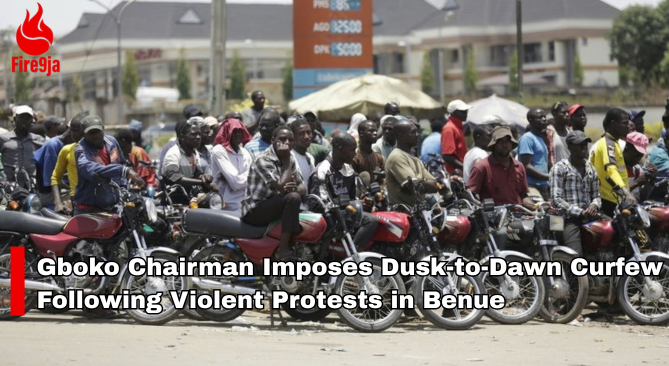
The Chairman of Gboko Local Government Area of Benue State, Torseer Yina, has imposed a dusk-to-dawn curfew in the ancient town.
The curfew takes effect from Thursday, October 8, 2026, following unrest and violent protests in the area.
According to reports, the action was taken to contain the unrest and violent protests by members of BEMOA following the death of one of its members by unknown gunmen.
The protest, which was reportedly hijacked by hoodlums, turned violent after an angry mob burnt two vehicles belonging to the Benue State Civil Protection Guards.
The Gboko council chairman said the curfew takes effect immediately and warned that anyone caught flouting the order or breaching public peace would be decisively dealt with.

Nine people have died in a fatal road crash along the Ijebu-Ode-Benin Expressway in Ogun State.
The crash occurred on Monday at about 4:55pm around the Bethel area along the Ijebu-Ode/Ore axis of the expressway. It involved a white Toyota Hiace commercial bus belonging to Delta Line and a white Sino truck operated by Bill Gas Solution Ltd.
According to the Federal Road Safety Corps (FRSC), all nine people involved in the crash, comprising three males and six females, died in the incident.
The FRSC said the crash occurred while it was raining and the road was wet, with preliminary investigations identifying speed violation as the probable cause.
The FRSC rescue team arrived at the scene shortly after receiving the report, while the bodies of the victims were taken to the General Hospital Morgue in Ijebu-Ode.
The Ogun State Sector Commander, Oludare Ogunjobi, urged motorists, especially commercial drivers, to obey speed limits and exercise extra caution when driving in the rain.

Minister of Education, Dr Tunji Alausa, speaks on the role and importance of teachers in the world to celebrate Teachers’ Day today.
He spoke on technology and its advancement and shared that while it is going well, teachers can never be replaced.
“These tools can help teachers reach learners and tailor instruction, but the judgement, encouragement and human connection of a skilled teacher remain indispensable,” he said.
“Every doctor, engineer, scientist, entrepreneur and public servant has benefited from a teacher and could not have become what they are today without teachers,” the minister said.
“When we honour teachers, we honour the people who make every other profession possible.”

Walid Acherchour Backs Lamine Yamal to Win 2026 Ballon d’Or

Zlatan Announces Wedding Date With Longtime Partner Davita

11 New K-Dramas To Add To Your Watch-list This October 2026


-

 Entertainment20 hours ago
Bridgerton Announces Violet and Edmund Love Story Spin-Off
-

 Entertainment20 hours ago
Mr Eazi Sparks Reactions With Comment About Expecting Twins
-

 Entertainment20 hours ago
From Men in Black to Aladdin: 10 Will Smith Movies
-

 Entertainment20 hours ago
10 Global Music Stars Who Became Famous At A Young Age
-
 Entertainment20 hours ago
11 New K-Dramas To Add To Your Watch-list This October 2026
-
 Sport20 hours ago
Walid Acherchour Backs Lamine Yamal to Win 2026 Ballon d’Or
-
 Entertainment20 hours ago
Zlatan Announces Wedding Date With Longtime Partner Davita