
Business
Lagos Residents Warn: Plastic Ban Could Trigger Job Losses and Water Crisis

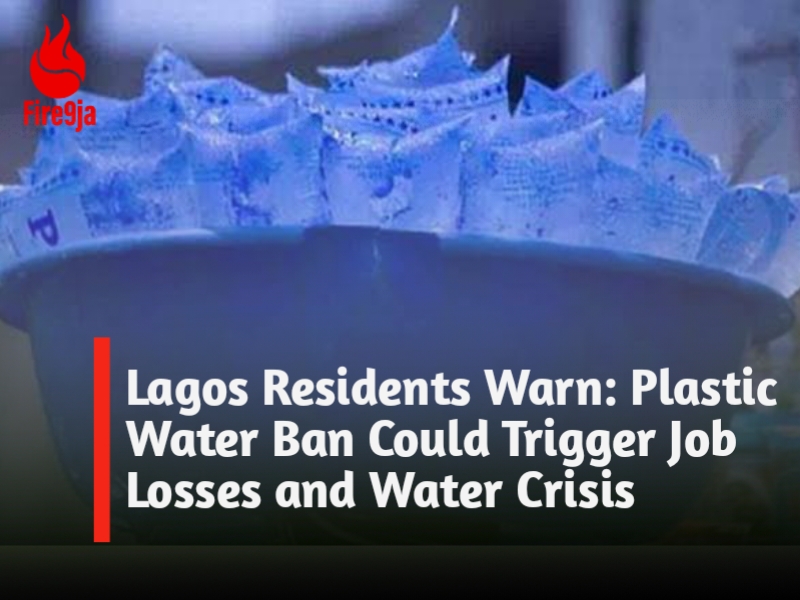
Residents of Lagos State are expressing concerns about the government’s proposed ban on single-use plastics (SUPs) and sachet water, warning that it could lead to widespread unemployment and disrupt key economic activities.
In various interviews, locals have called on the Lagos State Government to reconsider this decision, fearing the long-term effects on businesses and livelihoods, particularly in low-income communities.
The Lagos State Commissioner for the Environment and Water Resources, Tokunbo Wahab, recently announced the state’s intention to enforce the ban by January 2025 during a stakeholder workshop.
The policy aims to address the environmental hazards caused by plastic waste, which takes centuries to degrade.
The state is working in collaboration with private-sector organizations to identify alternatives to single-use plastics, such as styrofoam containers, and is also promoting research into eco-friendly technological solutions.
While environmentalists praise the move for addressing Lagos’ growing waste management problem, industry players, small business owners, and workers fear that the ban may lead to massive job losses, particularly in the manufacturing, distribution, and retail sectors.
Thousands of people depend on the production and sale of sachet water and plastic packaging for their income. Many are now uncertain about their future.
Akinyemi Bolaji, Sales Manager at Aremson Water Ltd. in Ojo First Gate, noted that many workers would be impacted by the ban.
He urged the government to explore alternative strategies that won’t lead to mass unemployment.
Bolaji questioned the rationale behind the ban, given the widespread reliance on sachet water as an affordable water source.
He called for better options for managing plastic recycling rather than an outright ban.
He also suggested that the government invest in education campaigns on proper waste disposal and provide more public trash bins to tackle Lagos’ drainage problems, which are often exacerbated by plastic waste.
For many Lagosians, sachet water, commonly referred to as “pure water,” is not only convenient but also vital for addressing public health concerns like cholera outbreaks.
A retail water seller, Mrs. Vera Osiyemi, expressed skepticism over the practicality of the ban, arguing that sachet water has been essential in combating diseases caused by unclean water.
According to her, a ban would likely force the city back to less hygienic practices like selling iced water in uncovered bowls.
Instead of a ban, she recommended the government focus on educating the public on proper disposal methods and reintroducing the widespread availability of bins, much like in past years.
Mrs. Afusat Ajibola, another seller, echoed these concerns, stressing that without adequate access to clean, affordable water, the ban could exacerbate health issues in Lagos.
Ajibola warned of a potential cholera outbreak if sachet water is banned without an effective alternative in place.
She doubted that the government’s efforts would succeed without addressing broader public health concerns tied to water accessibility.
Similar sentiments were shared by Miss Joy Okafor, a retailer who pointed out that plastic sachets are not the only source of blocked drainage systems in Lagos.
She noted that other types of disposable packaging also contribute to the problem.
Okafor raised concerns about whether the government would be able to provide sufficient clean water for every household and street in Lagos if the ban goes through.
She believes the government should tackle the issue of plastic disposal more directly rather than implement a full ban, which would likely result in job losses for many Lagosians who depend on selling sachet water.
Chinedu Eze, a long-time water distributor, said he is unsure what the future holds for his business if the ban takes effect.
For many like Eze, sachet water is more than just a product; it’s a critical source of income.
He emphasized that the ban could have devastating effects on the water distribution industry and the broader economy, particularly for those who have built their livelihoods around this trade.
A street vendor, identified as Mummy Boma, highlighted how selling sachet water allows her to feed her children and pay for their school fees.
She stressed that bottled water is too expensive for many consumers, as well as for small-scale sellers like herself who rely on high turnover to make a living.
Instead of banning sachet water, she recommended that the government enforce stricter regulations on manufacturers to ensure better quality control and hygiene standards.
From a public health perspective, medical professionals are also weighing in.
Dr. Olufemi Adeyemi, a Lagos-based physician, warned that an abrupt ban on sachet water could lead to reduced access to potable water for many residents.
While acknowledging that some sachet water may be contaminated due to poor regulation, Adeyemi emphasized that the government needs to provide alternative safe water sources before implementing such a ban.
He suggested that instead of banning sachet water outright, the state should invest in public water systems, ensuring clean and reliable water in both urban and rural areas.
According to him, such infrastructure could reduce the population’s dependency on sachet water and prevent the unintended health crises that could follow the ban.
Although the proposed ban is part of Lagos State’s broader environmental strategy, it is clear that the implementation will have far-reaching consequences for various sectors of the economy.
The key challenge now is finding a balance between environmental sustainability and economic survival for the thousands of Lagosians whose lives are tied to the production, sale, and consumption of sachet water and other single-use plastics.
Many residents hope that the government will take a more measured approach, exploring solutions that address both environmental and social concerns, such as improving waste management systems and ensuring access to clean, affordable water for all.















Bitcoin has fallen below $63,000, reaching its lowest level since October 2024 amid weakening investor confidence and increased volatility in the cryptocurrency market.
According to CoinMarketCap data, Bitcoin dropped 13.9 per cent to $62,965 as of 10:20 p.m. on Thursday. The decline comes after months of downward movement, with the cryptocurrency now more than 45 per cent below its October peak.
Ethereum also recorded a sharp decline, falling 13 per cent to $1,863, while the global cryptocurrency market capitalisation dropped to $2.19 trillion.
Analysts reportedly linked the latest decline to a broader sell-off in US technology stocks, which has also affected other risk assets. Bitcoin had reached an all-time high of more than $125,000 on October 5 before falling sharply in the days that followed, highlighting the continued volatility in the crypto market.

Businessman Aliko Dangote has explained why he believes Nigerians should participate in the ownership of his refinery by purchasing shares.
He was asked by singer Davido why Nigerians should participate, and Dangote explained that the initiative would help spread wealth and prosperity across Africa.
“Well, it’s very important because that is the only way to spread prosperity and wealth throughout Africa. And like I said, this is not going to be the first and the last. We will continue with even our fertilizer. By the time we finish listing, every single one will own part of our businesses and we will create a pool of cash…”
He explained that the goal is to create opportunities for more Nigerians to own a stake in the businesses and help spread wealth across the country.

Aliko Dangote speaks on his lineage and addresses not having a son as he was asked about not having a son to carry his name and achievements.
“That is not my priority because God controls everything. You can pray for God to give you a son, but he might be the one to take down the name of the family.”
Instead, he shared that he does not mind not having a son. “I don’t think a son would have done better than the three daughters I have.”
Aside from that, he was also asked about giving advice to young Nigerians. “Work hard, be consistent, focused and know what you want to do.”

Walid Acherchour Backs Lamine Yamal to Win 2026 Ballon d’Or

Zlatan Announces Wedding Date With Longtime Partner Davita

11 New K-Dramas To Add To Your Watch-list This October 2026


-

 Entertainment13 hours ago
Bridgerton Announces Violet and Edmund Love Story Spin-Off
-

 Entertainment13 hours ago
Mr Eazi Sparks Reactions With Comment About Expecting Twins
-

 Entertainment13 hours ago
From Men in Black to Aladdin: 10 Will Smith Movies
-

 Entertainment13 hours ago
10 Global Music Stars Who Became Famous At A Young Age
-
 Entertainment13 hours ago
11 New K-Dramas To Add To Your Watch-list This October 2026
-
 Sport13 hours ago
Walid Acherchour Backs Lamine Yamal to Win 2026 Ballon d’Or
-
 Entertainment13 hours ago
Zlatan Announces Wedding Date With Longtime Partner Davita