
News
Abia Residents Decry Soaring Petrol Prices, Rising Transport Fares, and Economic Hardship

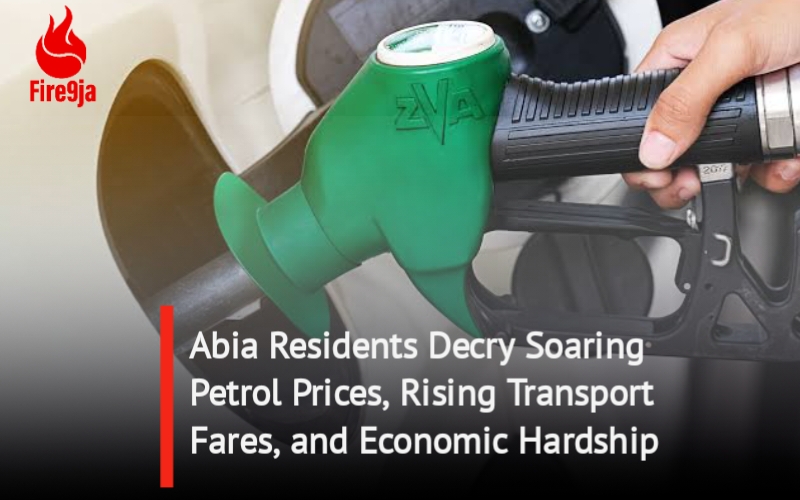
Transporters and commuters in Abia State have voiced significant concern over the recent surge in the price of Premium Motor Spirit (PMS), commonly referred to as petrol.
The price hike, which was announced by the Nigeria National Petroleum Company Limited (NNPCL), took effect on September 3, increasing the pump price from N617 per litre to a staggering N897 per litre.
This development has led to a chain reaction, causing a sharp rise in transportation costs and the prices of essential goods across the state.
According to reports from the News Agency of Nigeria (NAN), various transport operators and commuters shared their frustrations over the situation, describing it as “unbearable” for the average Nigerian citizen.
In separate interviews, they explained how the price increase is crippling their daily activities and making life more challenging.
A tricycle driver based in Aba, Enyichi Nnadede, explained his dilemma, noting that the soaring cost of petrol had made him question whether it was even worth going out to work.
He lamented that the high cost of fuel was leaving him with very little profit at the end of each day, making it difficult to provide for his family.
He shared, “Fuel is extremely expensive right now. We’re purchasing it at N1,200 per litre, and by the end of the day, we can hardly make enough to feed our families.”
He further criticized petrol dealers, accusing them of exacerbating the crisis. “Yesterday, fuel was sold at N870 per litre, but today it has jumped to N1,200. What could have possibly changed overnight?” Nnadede asked.
Another transporter in Umuahia, Agu Chukwuma, echoed Nnadede’s frustrations, saying he had purchased fuel for N1,100 per litre on the same day.
He expressed how the fuel price hike was eating into his already slim profit margins, making it almost impossible to sustain his transportation business. “We have no other source of livelihood.
The government is pushing us too far with these policies. They need to put an end to this economic hardship,” Chukwuma stated.
Commuters are not faring any better. A regular traveller between Aba and Umuahia, Adiele Chinaza, pleaded with the government to reconsider its policies, which he said were making life extremely difficult for everyday Nigerians.
“I have to travel from Aba to Umuahia every day for work, just like many other civil servants in Abia.
With transport fares skyrocketing, it will soon become impossible for us to meet up with our daily schedules,” he said. Chinaza highlighted that even the N70,000 minimum wage earned by civil servants would no longer be enough to meet basic living expenses under the current circumstances.
Residents of Umuahia are feeling the pinch as well. Onyinyechi Ekwonye, a concerned citizen, pointed out that the ripple effect of the fuel price increase would be felt in the prices of everyday goods and services.
“The rise in transport fares is already driving up the cost of goods. We’re caught in a situation where both the government and the traders are making life harder for the rest of us.
It feels like we’re being punished from all sides,” she remarked. Ekwonye urged the Nigeria Labour Congress (NLC) to step in and advocate for the people, saying the federal government’s policies were becoming too harsh for ordinary Nigerians to bear.
The consensus among the transporters, traders, and commuters in Abia is one of despair and frustration.
Many are calling on the government to find a solution to the fuel crisis and alleviate the mounting economic pressure on citizens.
The fear is that if nothing is done to address the soaring cost of living, many Nigerians may soon find themselves unable to afford necessities, leading to a deeper crisis across the nation.














The Chairman of Gboko Local Government Area of Benue State, Torseer Yina, has imposed a dusk-to-dawn curfew in the ancient town.
The curfew takes effect from Thursday, October 8, 2026, following unrest and violent protests in the area.
According to reports, the action was taken to contain the unrest and violent protests by members of BEMOA following the death of one of its members by unknown gunmen.
The protest, which was reportedly hijacked by hoodlums, turned violent after an angry mob burnt two vehicles belonging to the Benue State Civil Protection Guards.
The Gboko council chairman said the curfew takes effect immediately and warned that anyone caught flouting the order or breaching public peace would be decisively dealt with.

Nine people have died in a fatal road crash along the Ijebu-Ode-Benin Expressway in Ogun State.
The crash occurred on Monday at about 4:55pm around the Bethel area along the Ijebu-Ode/Ore axis of the expressway. It involved a white Toyota Hiace commercial bus belonging to Delta Line and a white Sino truck operated by Bill Gas Solution Ltd.
According to the Federal Road Safety Corps (FRSC), all nine people involved in the crash, comprising three males and six females, died in the incident.
The FRSC said the crash occurred while it was raining and the road was wet, with preliminary investigations identifying speed violation as the probable cause.
The FRSC rescue team arrived at the scene shortly after receiving the report, while the bodies of the victims were taken to the General Hospital Morgue in Ijebu-Ode.
The Ogun State Sector Commander, Oludare Ogunjobi, urged motorists, especially commercial drivers, to obey speed limits and exercise extra caution when driving in the rain.

Minister of Education, Dr Tunji Alausa, speaks on the role and importance of teachers in the world to celebrate Teachers’ Day today.
He spoke on technology and its advancement and shared that while it is going well, teachers can never be replaced.
“These tools can help teachers reach learners and tailor instruction, but the judgement, encouragement and human connection of a skilled teacher remain indispensable,” he said.
“Every doctor, engineer, scientist, entrepreneur and public servant has benefited from a teacher and could not have become what they are today without teachers,” the minister said.
“When we honour teachers, we honour the people who make every other profession possible.”

Walid Acherchour Backs Lamine Yamal to Win 2026 Ballon d’Or

Zlatan Announces Wedding Date With Longtime Partner Davita

11 New K-Dramas To Add To Your Watch-list This October 2026


-

 Entertainment6 hours ago
Bridgerton Announces Violet and Edmund Love Story Spin-Off
-

 Entertainment6 hours ago
Mr Eazi Sparks Reactions With Comment About Expecting Twins
-

 Entertainment6 hours ago
From Men in Black to Aladdin: 10 Will Smith Movies
-
 Entertainment6 hours ago
11 New K-Dramas To Add To Your Watch-list This October 2026
-

 Entertainment6 hours ago
10 Global Music Stars Who Became Famous At A Young Age
-
 Sport6 hours ago
Walid Acherchour Backs Lamine Yamal to Win 2026 Ballon d’Or
-
 Entertainment6 hours ago
Zlatan Announces Wedding Date With Longtime Partner Davita