
News
Everything You Need to Know About Tinubu’s State of Emergency in Rivers State

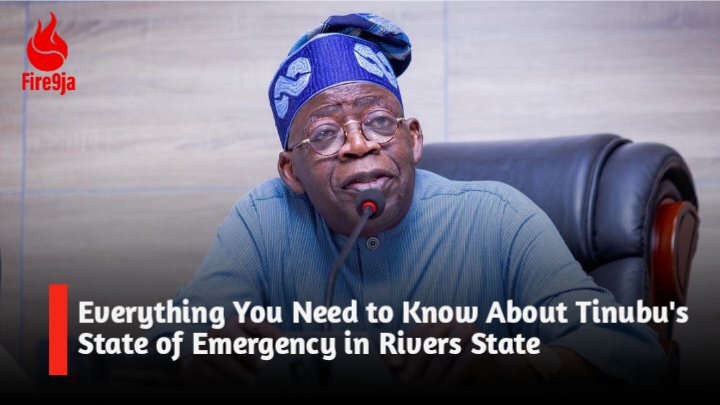
In March 2025, Nigeria’s political landscape was jolted by President Bola Tinubu’s declaration of a state of emergency in Rivers State, a pivotal region in the nation’s oil production. This unprecedented move, the first in over a decade, has been met with a spectrum of reactions, reflecting the complexity of the situation.
Genesis of the Crisis
The turmoil in Rivers State has been brewing for months, primarily due to a power tussle between Governor Siminalayi Fubara and factions within the opposition People’s Democratic Party (PDP).
Also, the discord escalated when state lawmakers initiated impeachment proceedings against Governor Fubara, accusing him of illegal budget presentations and issues related to the legislative chamber’s composition. This internal strife significantly hampered governance and stability in the state.
Compounding the political unrest, Rivers State experienced a surge in pipeline vandalism. Notably, a recent explosion on the Trans Niger Pipeline resulted in a fire outbreak, disrupting a major oil transportation route.
Furthermore, President Tinubu expressed concern over these incidents, mentioning the lack of effective action by the state government to address the sabotage, which poses threats to both the economy and environmental safety.
Presidential Intervention
In response to the escalating crisis, President Tinubu invoked Section 305 of the 1999 Constitution to declare a state of emergency in Rivers State on March 18, 2025. This action led to the suspension of Governor Fubara, Deputy Governor Ngozi Odu, and all members of the State House of Assembly for an initial period of six months.
Additionally, retired Vice Admiral Ibokette Ibas was appointed as the military administrator to oversee the state’s affairs during this period, with the judiciary remaining functional to ensure the rule of law.
Legislative Approval
Following the declaration, both chambers of the National Assembly—the Senate and the House of Representatives—endorsed the state of emergency.
Despite initial resistance from some opposition parliamentarians, the lawmakers acknowledged the necessity of the measures to address the pressing issues in Rivers State. The emergency rule is set to last for six months, during which the federal government will implement strategies to stabilize the region.
Diverse Reactions
The declaration has elicited a wide array of responses:
-
Legal Community:
The Nigerian Bar Association criticized the suspension of elected officials as illegal, arguing that a declaration of emergency does not automatically dissolve or suspend elected state governments.
-
Regional Organizations:
The Pan Niger Delta Forum (PANDEF) rejected the declaration, describing it as hasty and unjustifiable. They argued that the move was unnecessary and failed to address the real issues causing the political crisis in the state.
-
Political Analysts:
Also, figures like Dr. Reuben Abati, former media aide to President Goodluck Jonathan, labeled the declaration as an “impeachable offence,” asserting that the president lacks constitutional authority to remove a state governor through such a proclamation.
Rivers State, located in the Niger Delta, is vital for Nigeria’s crude oil production. The region has faced issues of pipeline sabotage that disrupt production and exports.











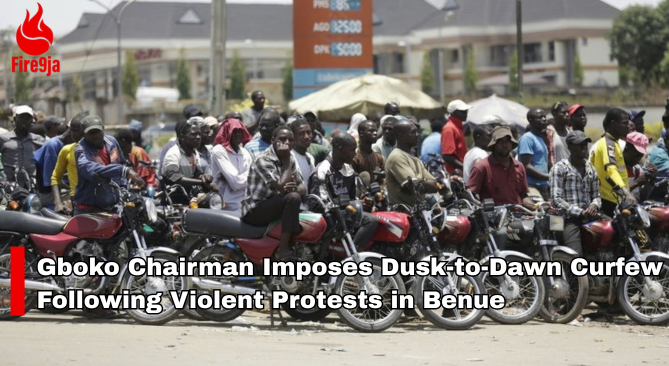
The Chairman of Gboko Local Government Area of Benue State, Torseer Yina, has imposed a dusk-to-dawn curfew in the ancient town.
The curfew takes effect from Thursday, October 8, 2026, following unrest and violent protests in the area.
According to reports, the action was taken to contain the unrest and violent protests by members of BEMOA following the death of one of its members by unknown gunmen.
The protest, which was reportedly hijacked by hoodlums, turned violent after an angry mob burnt two vehicles belonging to the Benue State Civil Protection Guards.
The Gboko council chairman said the curfew takes effect immediately and warned that anyone caught flouting the order or breaching public peace would be decisively dealt with.

Nine people have died in a fatal road crash along the Ijebu-Ode-Benin Expressway in Ogun State.
The crash occurred on Monday at about 4:55pm around the Bethel area along the Ijebu-Ode/Ore axis of the expressway. It involved a white Toyota Hiace commercial bus belonging to Delta Line and a white Sino truck operated by Bill Gas Solution Ltd.
According to the Federal Road Safety Corps (FRSC), all nine people involved in the crash, comprising three males and six females, died in the incident.
The FRSC said the crash occurred while it was raining and the road was wet, with preliminary investigations identifying speed violation as the probable cause.
The FRSC rescue team arrived at the scene shortly after receiving the report, while the bodies of the victims were taken to the General Hospital Morgue in Ijebu-Ode.
The Ogun State Sector Commander, Oludare Ogunjobi, urged motorists, especially commercial drivers, to obey speed limits and exercise extra caution when driving in the rain.

Minister of Education, Dr Tunji Alausa, speaks on the role and importance of teachers in the world to celebrate Teachers’ Day today.
He spoke on technology and its advancement and shared that while it is going well, teachers can never be replaced.
“These tools can help teachers reach learners and tailor instruction, but the judgement, encouragement and human connection of a skilled teacher remain indispensable,” he said.
“Every doctor, engineer, scientist, entrepreneur and public servant has benefited from a teacher and could not have become what they are today without teachers,” the minister said.
“When we honour teachers, we honour the people who make every other profession possible.”

Walid Acherchour Backs Lamine Yamal to Win 2026 Ballon d’Or

Zlatan Announces Wedding Date With Longtime Partner Davita

11 New K-Dramas To Add To Your Watch-list This October 2026


-

 Entertainment9 hours ago
Bridgerton Announces Violet and Edmund Love Story Spin-Off
-

 Entertainment9 hours ago
Mr Eazi Sparks Reactions With Comment About Expecting Twins
-

 Entertainment9 hours ago
From Men in Black to Aladdin: 10 Will Smith Movies
-
 Entertainment9 hours ago
11 New K-Dramas To Add To Your Watch-list This October 2026
-

 Entertainment9 hours ago
10 Global Music Stars Who Became Famous At A Young Age
-
 Sport9 hours ago
Walid Acherchour Backs Lamine Yamal to Win 2026 Ballon d’Or
-
 Entertainment9 hours ago
Zlatan Announces Wedding Date With Longtime Partner Davita