
News
NLC Agrees to N70,000 Minimum Wage After Fuel Price Rejection

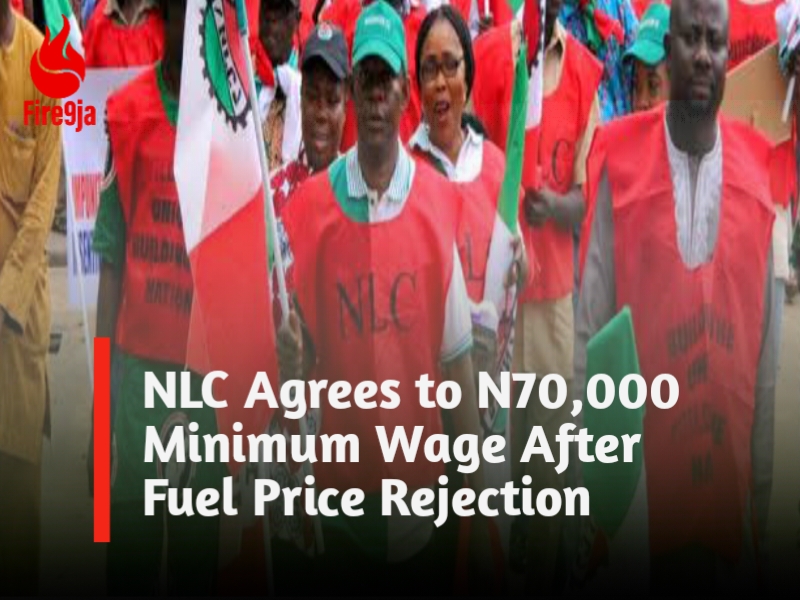
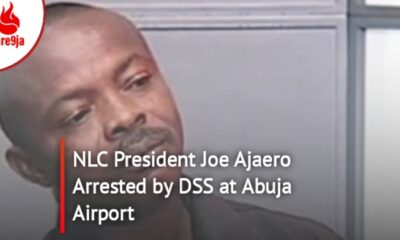
The President of the Nigeria Labour Congress (NLC), Joe Ajaero, has shed light on why the organized labour eventually accepted the N70,000 minimum wage during negotiations at the Presidential Villa in Abuja.
Speaking on Arise TV’s Morning Show, Ajaero detailed the events that led to the acceptance of the new wage offer, explaining the complexities involved in the discussions with President Bola Tinubu and his administration.
During the meeting with President Tinubu, the organized labour had initially held firm on a demand for a N250,000 minimum wage, arguing that the growing cost of living necessitated such an increase.
However, the talks stalled when the states expressed their unwillingness to pay even N62,000 as a new minimum wage.
This deadlock led to the meeting with the president himself.
Ajaero explained that President Tinubu sought to address not just the minimum wage issue but also the pricing of petroleum products, which had become a critical national concern since the removal of the fuel subsidy.
Tinubu suggested that in exchange for agreeing to an increase in fuel prices, he would raise the minimum wage to N250,000.
However, the labour leaders declined to engage in discussions about fuel price increases, stating that their mandate was strictly to negotiate wages, not fuel costs.
The president had also referenced the cost of fuel in neighboring West African countries, noting that many of them pay significantly more for petroleum products compared to Nigeria.
He proposed sending the labour leaders on a sponsored trip to these countries to see the pricing differences firsthand.
However, the NLC turned down the offer, stating they were not interested in international comparisons when the issue at hand was about the welfare of Nigerian workers.
During the negotiations, Tinubu reportedly told Ajaero that he was the one “holding my hand from increasing further” the price of petroleum, implying that the government’s preferred approach was to align fuel prices with global rates after the subsidy removal.
Yet, the labour leaders insisted that their primary focus was the welfare of Nigerian workers and that they would not engage in any discussions that included raising fuel prices.
In the meantime, the labour representatives had earlier agreed on an alternative energy source, Compressed Natural Gas (CNG), with the government.
They negotiated with experts who estimated the cost of converting vehicles to CNG at N300,000 per vehicle.
However, when this proposal was presented to government officials, the figure was rejected, and the officials claimed that the conversion would actually cost N800,000 per vehicle, a sum far higher than what the labour leaders had negotiated.
Despite these setbacks, the labour movement decided to accept the N70,000 minimum wage offer. Ajaero emphasized that this decision was reached after careful deliberation and consultation.
The NLC believed that while the N70,000 figure was far below their original demand, it was still a step forward in the ongoing fight for improved worker welfare in Nigeria.
When asked whether the NLC felt betrayed by President Tinubu over his stance on the petrol pump price, Ajaero explained the intricacies of the discussions, stating that the labour movement never agreed to any fuel price hikes.
He clarified that the focus of their talks had always been on minimum wage, and they stood firm on refusing to negotiate any further increases in fuel prices as part of the wage deal.
Ajaero concluded by reaffirming the NLC’s commitment to protecting workers’ rights and ensuring that future negotiations with the government focus solely on improving the welfare of Nigeria’s workforce.
While the NLC ultimately accepted the N70,000 offer, the larger conversation surrounding the fuel subsidy, rising living costs, and government accountability remains an ongoing challenge for the labour movement.









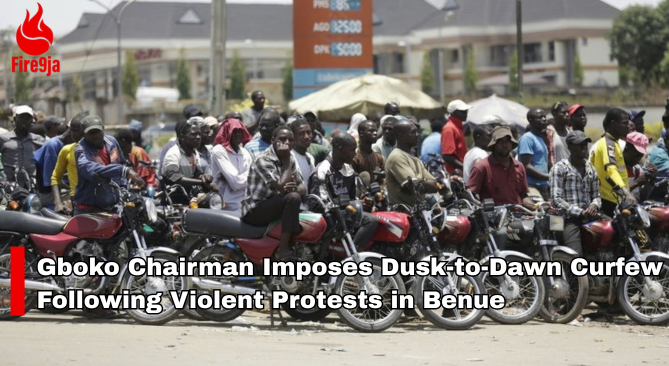
The Chairman of Gboko Local Government Area of Benue State, Torseer Yina, has imposed a dusk-to-dawn curfew in the ancient town.
The curfew takes effect from Thursday, October 8, 2026, following unrest and violent protests in the area.
According to reports, the action was taken to contain the unrest and violent protests by members of BEMOA following the death of one of its members by unknown gunmen.
The protest, which was reportedly hijacked by hoodlums, turned violent after an angry mob burnt two vehicles belonging to the Benue State Civil Protection Guards.
The Gboko council chairman said the curfew takes effect immediately and warned that anyone caught flouting the order or breaching public peace would be decisively dealt with.

Nine people have died in a fatal road crash along the Ijebu-Ode-Benin Expressway in Ogun State.
The crash occurred on Monday at about 4:55pm around the Bethel area along the Ijebu-Ode/Ore axis of the expressway. It involved a white Toyota Hiace commercial bus belonging to Delta Line and a white Sino truck operated by Bill Gas Solution Ltd.
According to the Federal Road Safety Corps (FRSC), all nine people involved in the crash, comprising three males and six females, died in the incident.
The FRSC said the crash occurred while it was raining and the road was wet, with preliminary investigations identifying speed violation as the probable cause.
The FRSC rescue team arrived at the scene shortly after receiving the report, while the bodies of the victims were taken to the General Hospital Morgue in Ijebu-Ode.
The Ogun State Sector Commander, Oludare Ogunjobi, urged motorists, especially commercial drivers, to obey speed limits and exercise extra caution when driving in the rain.
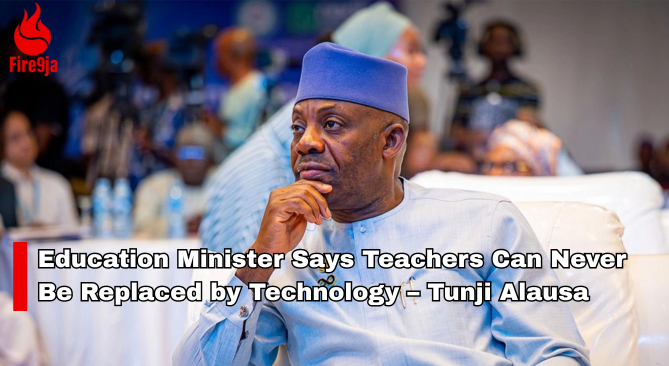
Minister of Education, Dr Tunji Alausa, speaks on the role and importance of teachers in the world to celebrate Teachers’ Day today.
He spoke on technology and its advancement and shared that while it is going well, teachers can never be replaced.
“These tools can help teachers reach learners and tailor instruction, but the judgement, encouragement and human connection of a skilled teacher remain indispensable,” he said.
“Every doctor, engineer, scientist, entrepreneur and public servant has benefited from a teacher and could not have become what they are today without teachers,” the minister said.
“When we honour teachers, we honour the people who make every other profession possible.”

Walid Acherchour Backs Lamine Yamal to Win 2026 Ballon d’Or

Zlatan Announces Wedding Date With Longtime Partner Davita


